
A daily entry, generated from what really happened
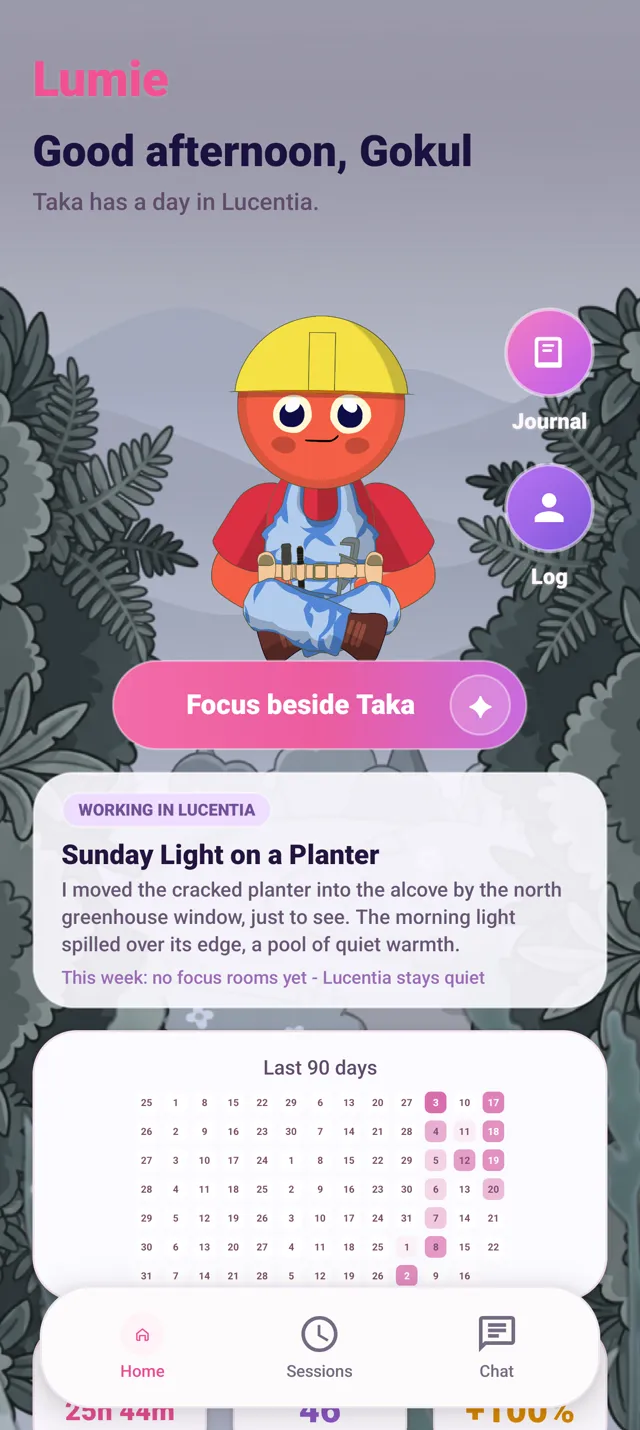
Each day, your focus sessions, spoken intentions, and conversations become one journal entry — written in Lumie's voice, set somewhere in Lucentia.
- A title and a mood — "Sunday Light on a Planter," quietly warm.
- A place in Lucentia — the greenhouse, the ship, the garden.
- Sometimes a picture — a generated illustration of the scene.
- An archive — every entry kept by date, ready to reread.
- A story underneath — some pages hold fragments Lumie can't quite place. A familiar handwriting. A door that hums. Keep reading.
On a week with no focus rooms, the entry says so: "Lucentia stays quiet." The journal never flatters you — that's why it's worth reading.
Mornings start with an intention
Once a day, Lumie offers a single line to aim yourself by — a daily intention, shown before anything else. Mark it seen, carry it with you, and let the rest of the app get out of your way.
- One intention per day — no queue of quotes, no infinite feed.
- A gentle nudge — an opt-in notification when your journal is ready.
- The story so far — today's Lucentia story progress, right on the dashboard.
Lumie remembers like a friend,
not like a database.
Lumie keeps useful context — your goals, your streaks, the thing you said you were afraid of on Tuesday — so conversations build on each other. It summarizes and moves on; it doesn't hoard everything forever. And when you say delete, everything goes.